Publications
Frameworks and case studies developed from real-world implementation. Each publication is designed for practical application.

Cyberspace Psychosis and The Virtual Reality Blues
Cyberspace Psychosis and the Virtual Reality Blues is an exercise in Applied Neurodivergence, using pattern seeking through the lens of Alfred Korzybski's map is not the territory to dissect the effect cyberspace has had on Western life. Across thirteen movements, the book traces that effect through the systems where the damage shows up most clearly: the media, money, personal connection, mental health, AI, the credential crisis, and the strange new business of selling us back to ourselves.
This isn't a book written from above the problem. Hickey writes as what he calls an infected participant, someone inside the same systems he's critiquing, scrolling the same feeds, fighting the same compulsions, watching the same friends lose the plot. The result is a book that's rigorous without being academic, funny without being glib, and honest about the fact that none of us are getting out of this clean. It's a field report from inside the machine, written for readers who already suspect something is wrong and want a framework sharp enough to name it.
Click the Cover to learn more.

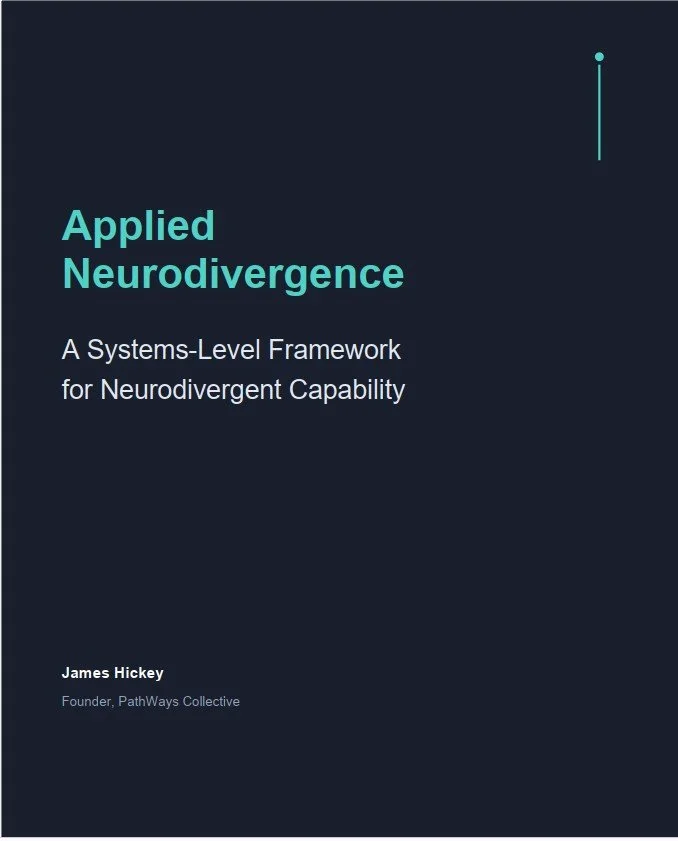
Applied Neurodivergence: A Systems-Level Framework for Neurodivergent Capability
Applied Neurodivergence: A Systems-Level Framework for Neurodivergent Capability explains what Applied Neurodivergence is and why it matters. The guide defines Applied Neurodivergence as a methodology, not an identity label, built on four core cognitive operations: bottom-up processing, advanced pattern recognition, predictive risk orientation, and systems thinking. It reframes neurodivergent cognition from a liability requiring accommodation to an operational asset that can be deliberately deployed.
Written for neurodivergent professionals, organizational leaders, and anyone looking to understand this emerging framework, the guide grounds the concept in research and provides practical context for how these cognitive patterns translate into real-world capability.
Click the Cover to read the full PDF
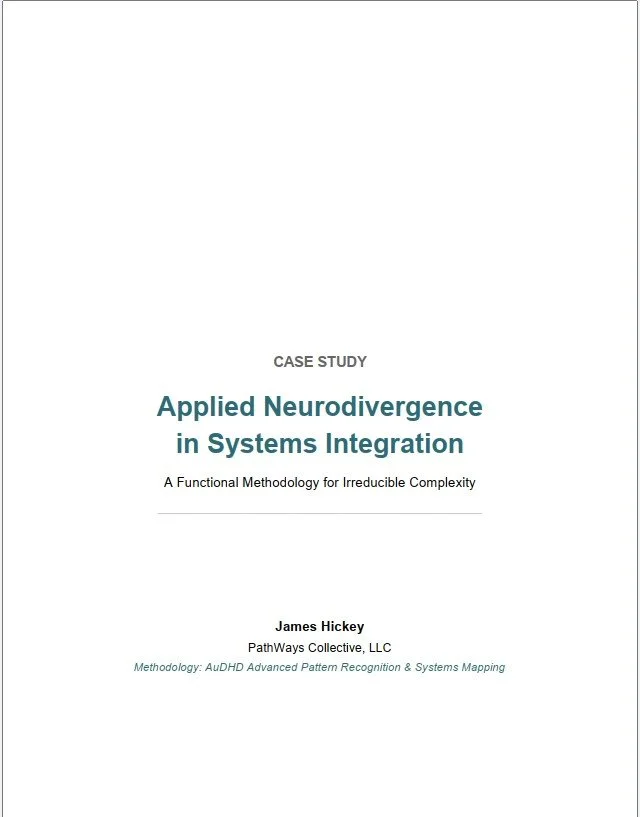
Applied Neurodivergence: A Case Study in Systems Integration
This case study documents Applied Neurodivergence as a functional methodology for resolving irreconcilable system constraints. Using From Liquor to Dhikr as the primary artifact, it demonstrates how bottom-up processing, advanced pattern recognition, and constraint-based integration can produce coherent outcomes where conventional, top-down approaches predict failure.
The paper serves as proof-of-capability rather than thought leadership, formalizing a repeatable approach to complex systems integration across incompatible frameworks.
Click the Cover to read the full PDF.